My goodness we looked at a lot of different herbs during
this class. We did not take photos but I have some I took before and after
class that will help you to remember most of the plants we saw this May. I have also noticed that those of you receiving this blog by email are still getting the words rearranged and the photos are out of place. You might come direct to the blogsite to read these blogs so you get the original typeset.
 |
| Echinacea tincture in bottles |
We started class by filtering our Echinacea purpurea
tincture and everyone got to take some home with them. We also pressed out our
vinegar extract started from the prior class and added dried ginger and nettle
to it.
As soon as we were done with our inside fun, we moved
outside to enjoy the sunshine and look at herbs.
Herb Walk
 |
| Celandine flower |
We looked at Greater Celandine - Chelidonium majus which
was in flower. We examined the bushy plant and noted that when you break the
stem an orange colored sap oozes out. This sap has escharotic activity. This means it eats away at tissue. It is used to eat away warts. This plant is in the same family as Bloodroot that we saw last
week and the Opium poppy. That family is Papaveraceae. Although it has been
used historically for liver disease, we discussed the cases of cholestatic
hepatitis that has taken place with this plant and the possibility that it might be more
of a choleretic than cholagogue which might cause a problem for folks if they
don’t use an additional cholagogue with it. However, it is best for folks who
are not a skilled practitioner to simply not use this plant internally. This
plant is also an ingredient in the injectable cancer medicine called Ukraine.
 |
| Angelica archangelica spring |
We collected quite a few roots. We dug up some Angelica
archangelica, Geranium root, Poke root and Yerba mansa root. We also
collected some Plantain. We took
our roots inside and cleaned them.
 |
| Angelica early summer |
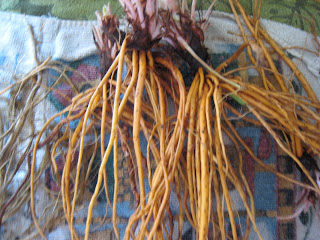
The Angelica archangelica, Geranium maculatum and Yerba mansa are all drying as
well as the plantain.
Angelica - Angelica archangelica is a wonderful carminative that not only helps with
gas but is also useful as an antimicrobial and antispasmodic in food poisoning
formulas. It also makes a pleasant addition to cough formulas as an expectorant
and antimicrobial.
 |
| Geranium late spring |
Geranium - Geranium maculatum is a strong astringent. I know you all know what
astringents do in detail and won’t go over that again. This is one of my
favorite astringents although there are so many at our beck and call.
 |
| Yerba mansa - late spring |
Yerba mansa - Anemopsis californica is so darn good smelling. I just can’t get
enough of the smell of those roots.
Another astrinent but also anti-inflammatory, antibacterial, antifungal
and a diuretic. It is wonderful in sore throat formulas of both viral and
bacterial nature.
 |
| Plantago lanceolata |
Plantain - Plantago laceolata and major is such a fantastic herb. It is healing to the skin
and mucous membranes. It is my favorite herb to use as a healing spit poultice.
I put it in healing salves and use it internally any time I want to heal up an
irritated mouth, throat or gut. It is also soothing to the urinary tract. It is an all around wonderful vulnerary. It will
decrease inflammation and has some direct antibacterial action.
 |
| Poke - spring |
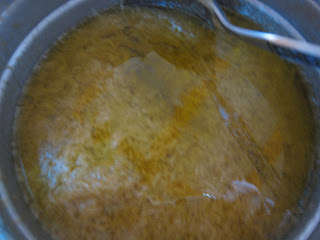
The Poke root - Phytolacca decandra (americana) went into olive oil to make a Poke oil and the
other roots are drying on drying racks. There are photos of them drying at the end of this blog. The Plantain is also drying and will be used as part of
a healing salve that we will make in another month or two. As always, we tasted
the roots to get better aquainted with the plants.
 |
| Poke in oil heating slowly |
 |
| Poke oil filtering |
We discussed that Poke is a low dose botanical and can be
toxic so only trained professionals should use this plant. Poke root oil is
used externally for mastitis and over enlarged lymph nodes. The root is also
used internally in small doses as a lymphogogue. Practitioners use it as a
lymphagogue in cancer protocols as well as for acute and subacute infectious
conditions with lymphatic stagnation and enlarged lymph nodes. We discussed
specific situations it is used in such as strep throat. Poke is specific for
hard enlarged lymph nodes.
We took another look at Bloodroot to see what it looks like
as it is growing.
 |
| Goldenseal flower |
Goldenseal - Hydrastis canadensis was also up. It is growing in the same bed as the bloodroot as
they both like to grow in 75% shade. The Goldenseal was starting to bloom.
Goldenseal is bitter, astringent,
antimicrobial, laxative, styptic and adrenolytic. It contains berberine which
is the same constituent we talked about for way too long when we looked at
Oregon Grape.
 |
| Cramp bark flowering |
The Cramp Bark - Viburnum opulus
 |
| Cramp bark bush |
was blooming. The bark of
this large bush is a wonderful nervine. It is a very strong antispasmodic.
Although best known for use in menstrual cramps, it is useful for all manner of
spams be they of skeletal muscle tissue or smooth muscle fibers. This means it helps with
stones causing gall bladder spasms and ureter spasms as well as spastic muscles
when you tweak your back. It
relaxes the muscles in your arteries thereby lowering blood pressure and yes it
does relax the uterus when it is spastic so it has been used in menstrual
cramps and threatened miscarriage due to spasms and premature contractions.
After labor its ability to act as an astringent helps restore normal tone and
prevent uterine prolapse. I think the plant is under utilized. It’s fruits are
antioxidant and high in vitamin C and flavonoids. They have also been shown to
have gastrodudodenal protective effects. The berries have been shown to increase
super oxide dismutase and glutathione peroxidase.
 |
| Wild ginger flower |
I just love seeing the Wild Ginger - Asarum caudatum blooming. It is gorgeous.
I pointed it out to everyone as it is one flower you just do not want to miss.
I warned folks that the roots contain aristolochic acid and so it should never
be used except in very small amounts if at all. It does have a ginger taste to
it and many have used it for its flavor as well as its medicinal effects but
due to it having the possible side effect of damaging your kidneys, I suggest
folks just admire its beauty.
 |
| back of leaf on Cascara |
 |
| front of leaf on Cas |
We examined the Cascara - Rhamnus purshiana by the creek. We discussed the use
of Cascara bark the week before but did mention once again that it is a strong purgative laxative
and should be dried and aged one year before using.
 |
| Istatis tinctoria |
|
|
|
The Isatis tinctoria was blooming. This herb is used in
Chinese medicine a lot. It seems to be their go to herb for both viral and
bacterial sore throats and other infections of a contagious nature according to
Michael and Lesley Tierra. If you are interested in Chinese herbal medicine I
suggest you get their book called Chinese Traditional Herbal Medicine Volume II
– Materia Medica and Herbal Resource. Both the leaf parts as well as the roots
are used. I have not tried this plant myself yet but intend too soon. You can get their book directly from them at their website here.
 |
| Sterile horsetail shoot |
Horsetail - Equisetum arvense was at the perfect stage for harvesting. I missed
getting it this year. Darn! It is a great source of soluble silica, but you
have to get the sterile shoots before they get very big. They should look like
they do in this photo. Don’t bother harvesting them when they are bigger as the
silica will not be soluble and useful any more. This soluble silica is helpful
for growth of bones, cartilage, hair, nails, and skin. Horsetail is also a diuretic and
astringent and is used sometimes in urinary tract problems where there is
passive bleeding such as gravel or inflammatory bacterial infections. Don’t
take too much horsetail without taking vitamin b1 (thiamine) as it contains
thiaminase and can deplete thiamine when used long term.
 |
| Caraway in bloom |
Caraway - Carum carvi was also blooming. This spicy and aromatic seed is used as a carminative, antispasmodic and galactagogue.
 |
| Blueberries |
Blueberry/Bilberry/Huckleberry - Vaccinium spp.
We looked at the blueberries. (Remind me I need to show you the huckleberries next class.) These plants, especially the berries are high in anthocyanins. Anthocyanins have more research on them than you can shake a stick at. Basically they are strong antioxidants and perform a great job stabilizing collagen, and maintaining elastin. This supports connective tissue which is found all through-out our body as the most abundant tissue in our bodies.
The leaves are high in chlorogenic acid. Plants with clorogenic acid seem to be all the rage as a diet aid nowadays.
So, you won't be surprised to find out this group of plants has a wide range of uses. The leaves have a history of being used as a hypoglycemic and recently there has been research showing the berries may also be hypoglycemic. This sheds light on why so many diabetics have reported being able to eat them. They do contain sugar so I always warn diabetics to be cautious if they try eating them. Research does show that a diet rich in blueberries decreases the chance of both cardiovascular disease and diabetes. The berries are used for hyperlipidemia, protection from vascular damage, easy bruising, enhancement of cognitive abilities, hypertension, neurodegeneration, rheumatoid arthritis, obesity and the list just goes on and on. The leaves are astringent and as such can cause gastrointestinal irritation if ingested in excess. This is similar to black tea which is also astringent.
If you grow your own blueberries or you pick at a local organic farm, you can preserve them by either drying or freezing the berries. Both methods will maintain the anthocyanin content. This way you can eat these tasty treats all winter long!
I also have some photos of various things drying. Here they are:
 |
| Yerba mansa before cutting it up. |
 |
| Yerba mansa on top and geranium on bottom |
 |
| Geranium roots prior to cutting up |
 |
| Plantain drying |
It has been so long since class that I probably forgot some
of the things we looked at. I know we discussed Osha but I did not take any photos and we saw quite a few additional things at the creek. Sorry, I did not get them all posted here. Wait until
you see how much we have to look at next class. All the plants are delighting in
the rain and warm weather and growing… well like weeds.
See you all soon. Take good notes at our summer classes and bring your camera as I will not be posting notes much the rest of the summer.


